‘This Guy Just Gets It’: Artist Griffin McTavish
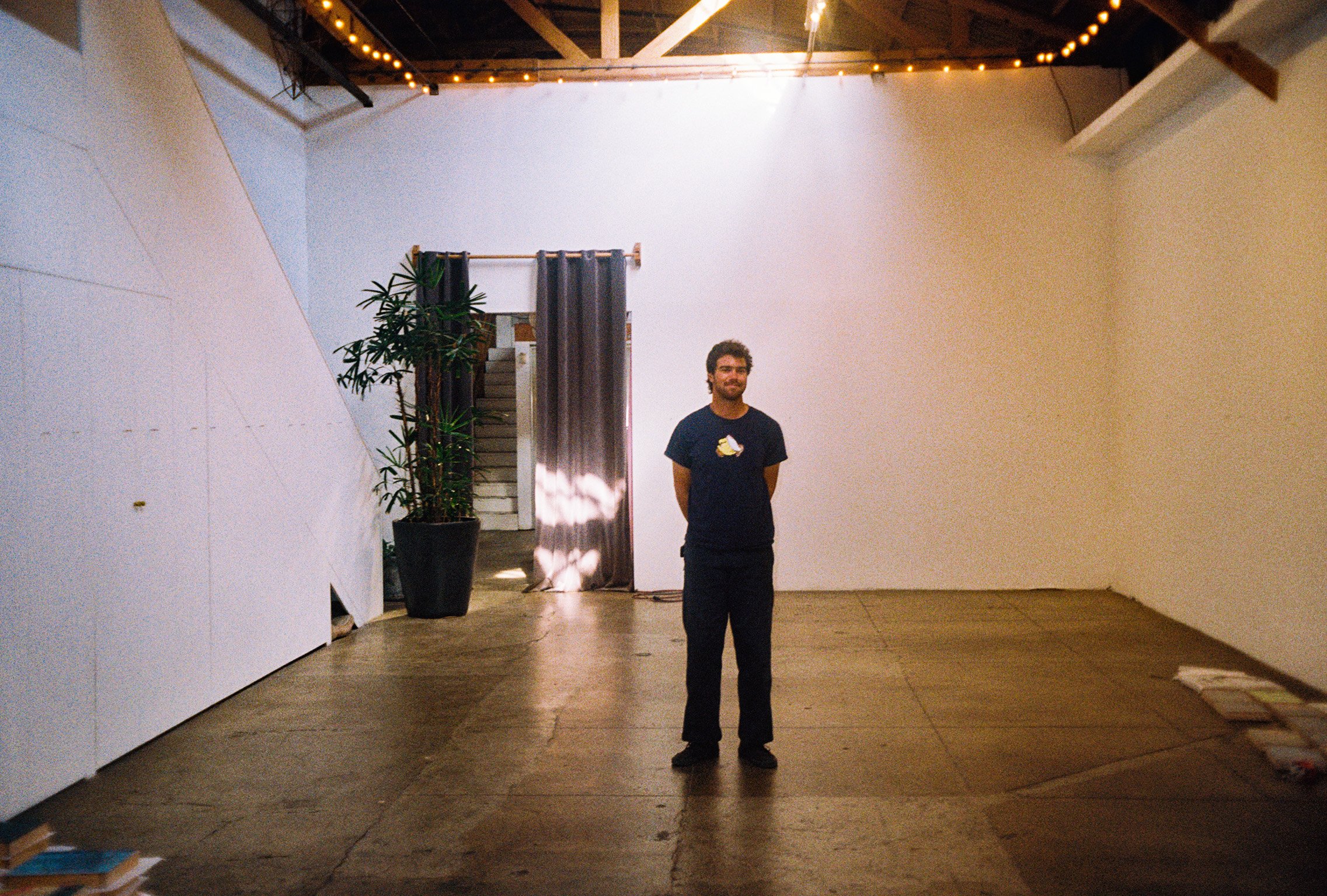
words and photography by Sierra skinner.
I have been to countless shows in and around Los Angeles, many of them forgettable if not downright disappointing.
It’s entirely too easy to become numb to it, to give in to the overstimulation and the repetition. Pull up to the opening just to say that you did, cast a couple unfocused glances in the direction of the work, grab a free beer, and then waste away the rest of the night chainsmoking out front trying to find the next moves. We’re a spoiled bunch verging on downright aesthetic gluttony. Some of the greatest minds of our generation walk amongst us and we are showing them the same dismissal as a sticky-fingered kid choosing junk food over sustenance. Full but malnourished, overstimulated but under-inspired. Pitifully disengaged.
Lucky for me and all other terminal optimists gritting their teeth as we try to insist that it’s not all a lost cause, prodigies still persist. Prodigies like my friend Griffin.
Griffin Mactavish has snapped me out of an accidental slip into apathy on two notable occasions now. The first took place on an overcrowded Zebulon patio, when Griffin caught me staring boredly off into space and lifted a tiny cow figurine he had been keeping in his pocket into my field of vision with his trademark grin on full display. We both dropped to the floor in sync when he dropped the tiny cow moments later, iphone flashlights on to recover this precious item from the sea of cigarette butts. A kindred spirit, a fellow appreciator of the little things. This guy just gets it.
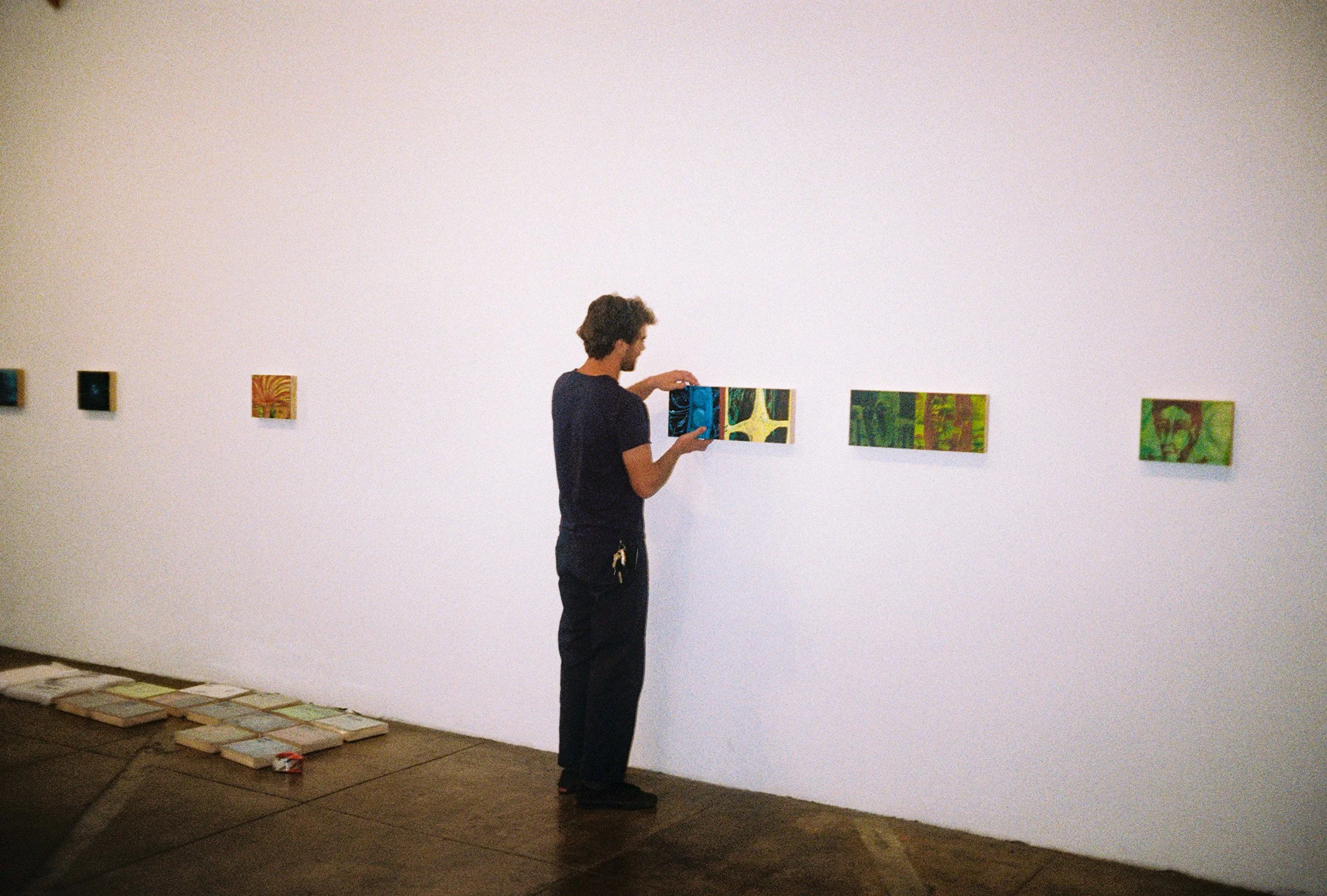
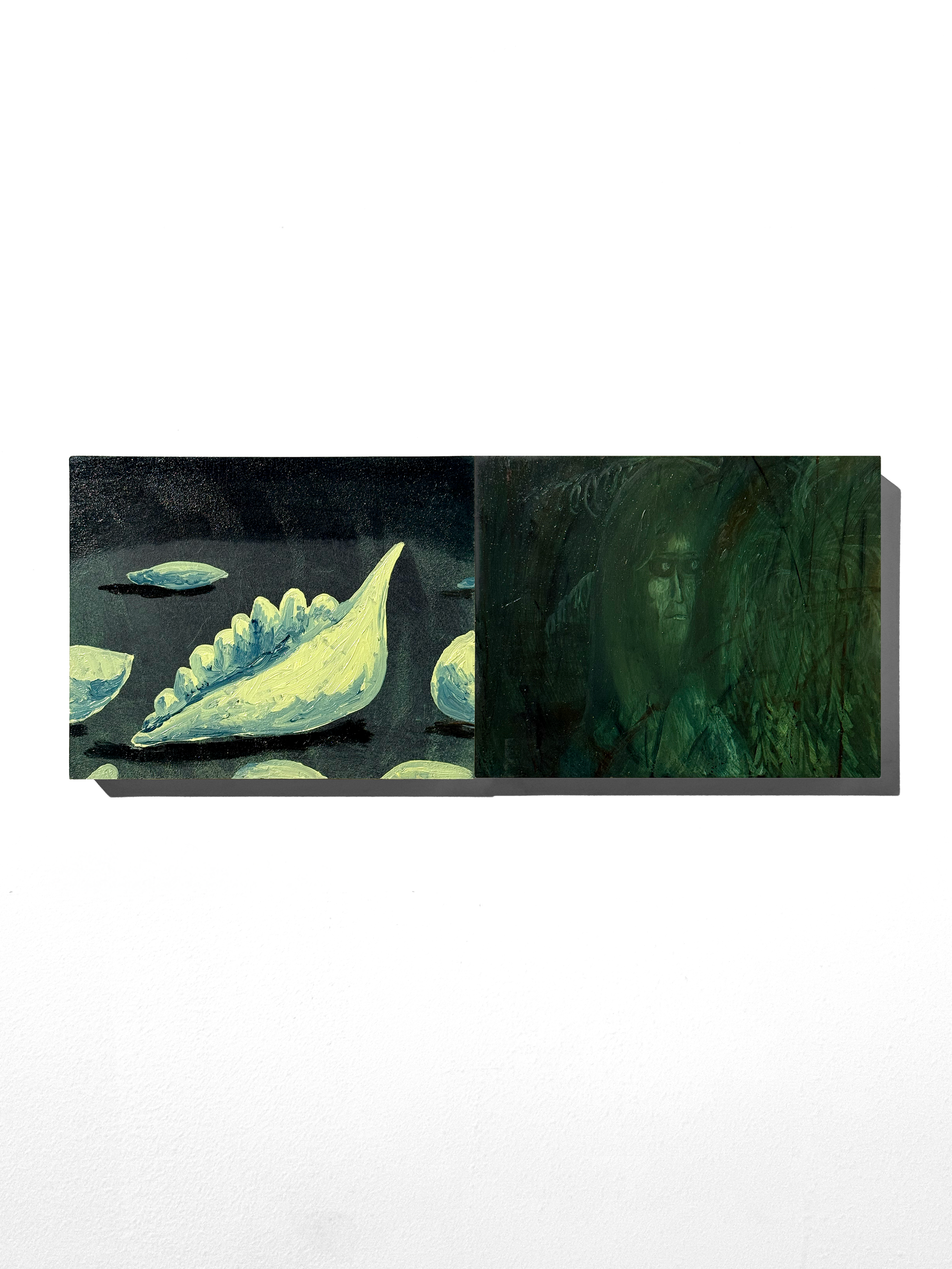
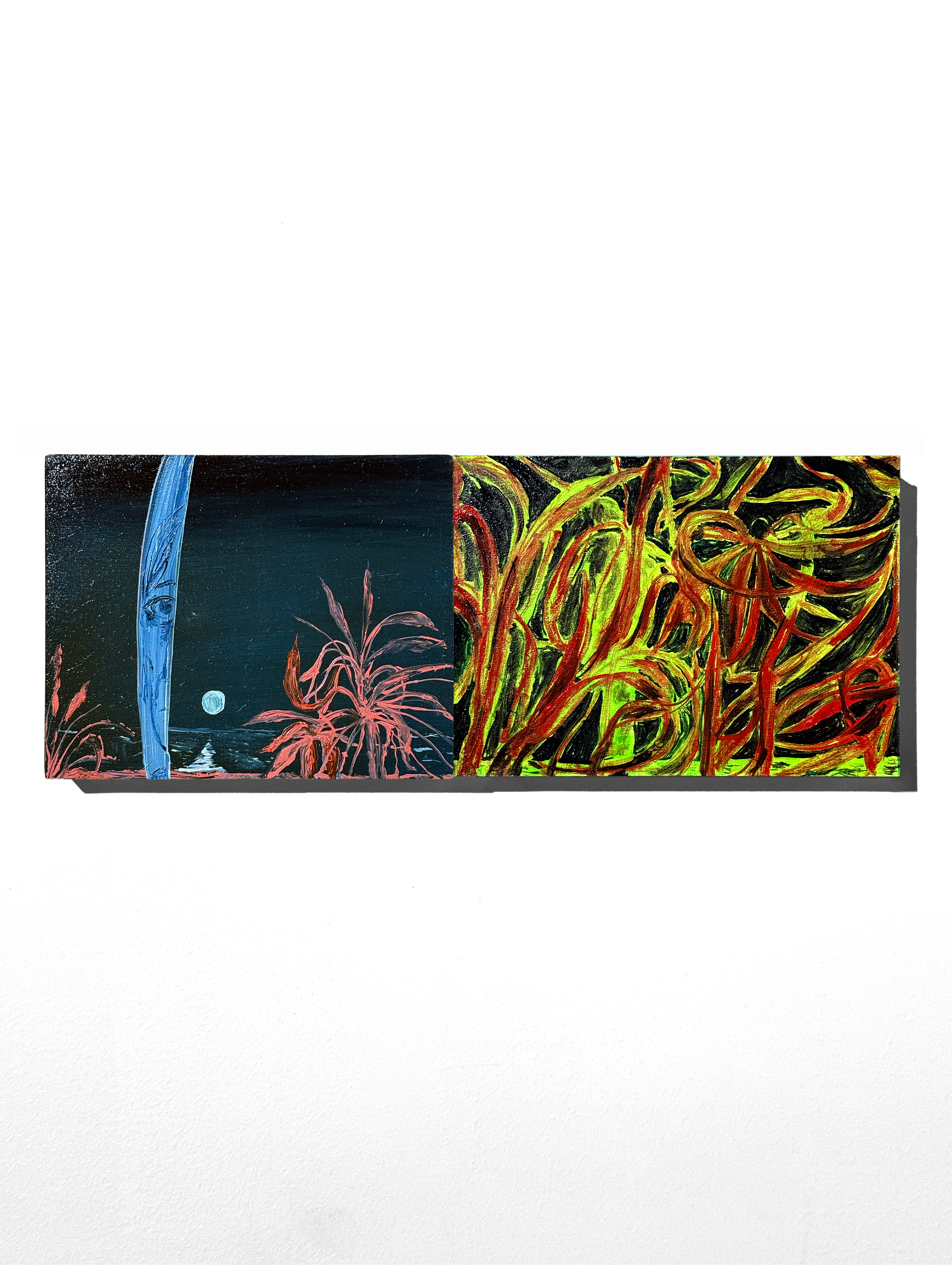
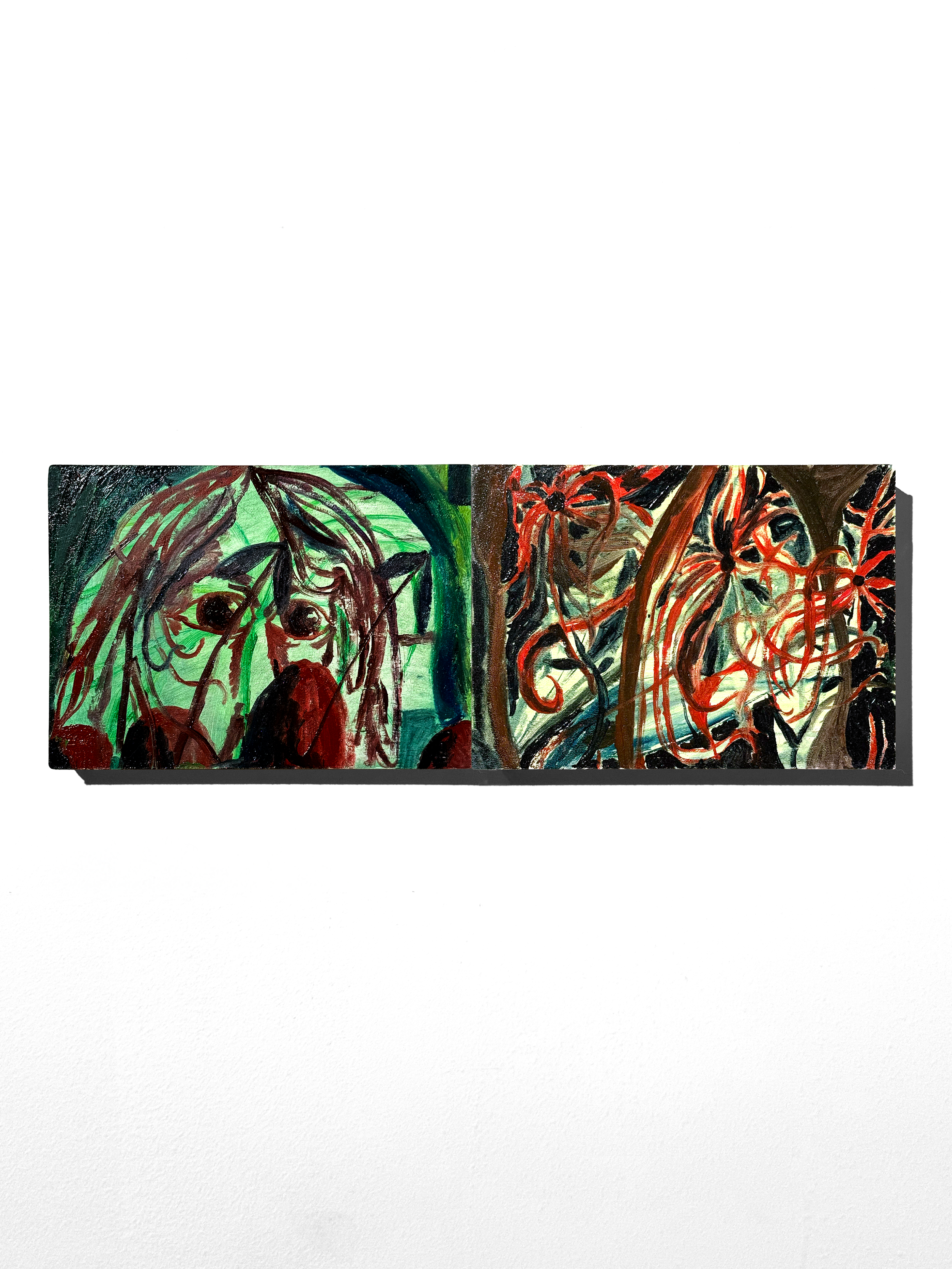
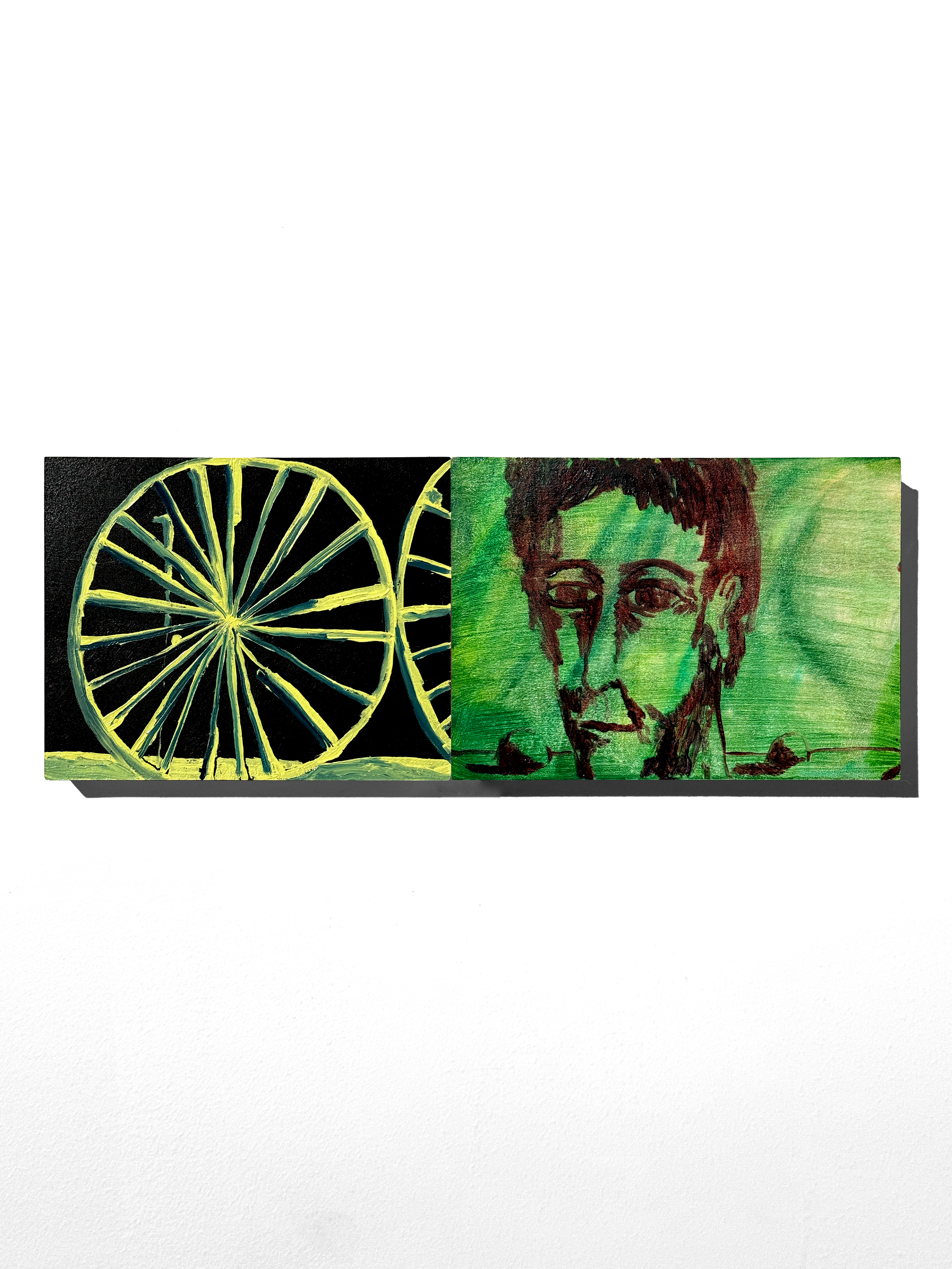
The second Griffin Mactavish sponsored break in monotony occurred a mere few weeks later at the closing reception of his debut solo show, Wilderness Skills, at Lonestar Projects. This collection is otherworldly in both execution and presentation– more than sixty original paintings belt the walls of the space, thoughtfully paired off into diptychs that suggest relation but don’t give it away. Repeating motifs of wagon wheels, plant tendrils, pea pods, wide-eyed faces, all gently distorted. What Griffin has managed to do here is nothing short of alchemical, turning the simple into fable in a manner characteristic of his temperament. Griffin is gracious, refreshingly unpretentious, open-hearted and engaging. His work reflects this masterfully.
My mind felt reactivated as I joined the rest of the crowd assembled to hear Griffin in conversation with his longtime friends and collaborators, Lonestar Projects founder Alex Carmen and writer Maria Camacho. We all listened quietly and earnestly, sharing in an unspoken understanding that the energy cultivated by both Griffin’s presence and work is something to be appreciated with sincerity. The trio spoke about this experience of world building and the open exchange of ideas that culminated in Wilderness Skills.
Conversation gave way to a night of live music by more local luminaries Albert Peacock, Sam Takano, Dillon Lee, and Alex Carmen himself. The soundtrack was both intentional and improvisational, resonating as a sonic transmission of the works that surrounded us. Nights like these feel redemptive, a moment to remember just how good it can be when we all come together with the kind of pure spirit that these multifaceted visionaries exude and inspire. Feeling the potential energy of ideas newly percolating, feeding off of each other like symbiotic creatures sharing inspiration as a life force. I’m a sucker for this stuff, and it’s good to know I’m not alone.
So many connections here start and stop at drinking buddy small talk, lingering in the purgatory of parasociality. The way we tend to interact in the art sphere is a particularly egregious example: we are so worried about sounding smart that we often say nothing at all. Questions go unanswered or unentertained entirely and our precious sense of curiosity continues to atrophy. We’re showing up, but many are missing out on all the best parts of being here in this epicenter of creativity with our incessant cool-guying. As much as I despise it, I do get it. I’ve unfortunately submitted to this pressure plenty of times but was determined to not perpetuate this pattern further when joining Griffin for deinstall a few days later.
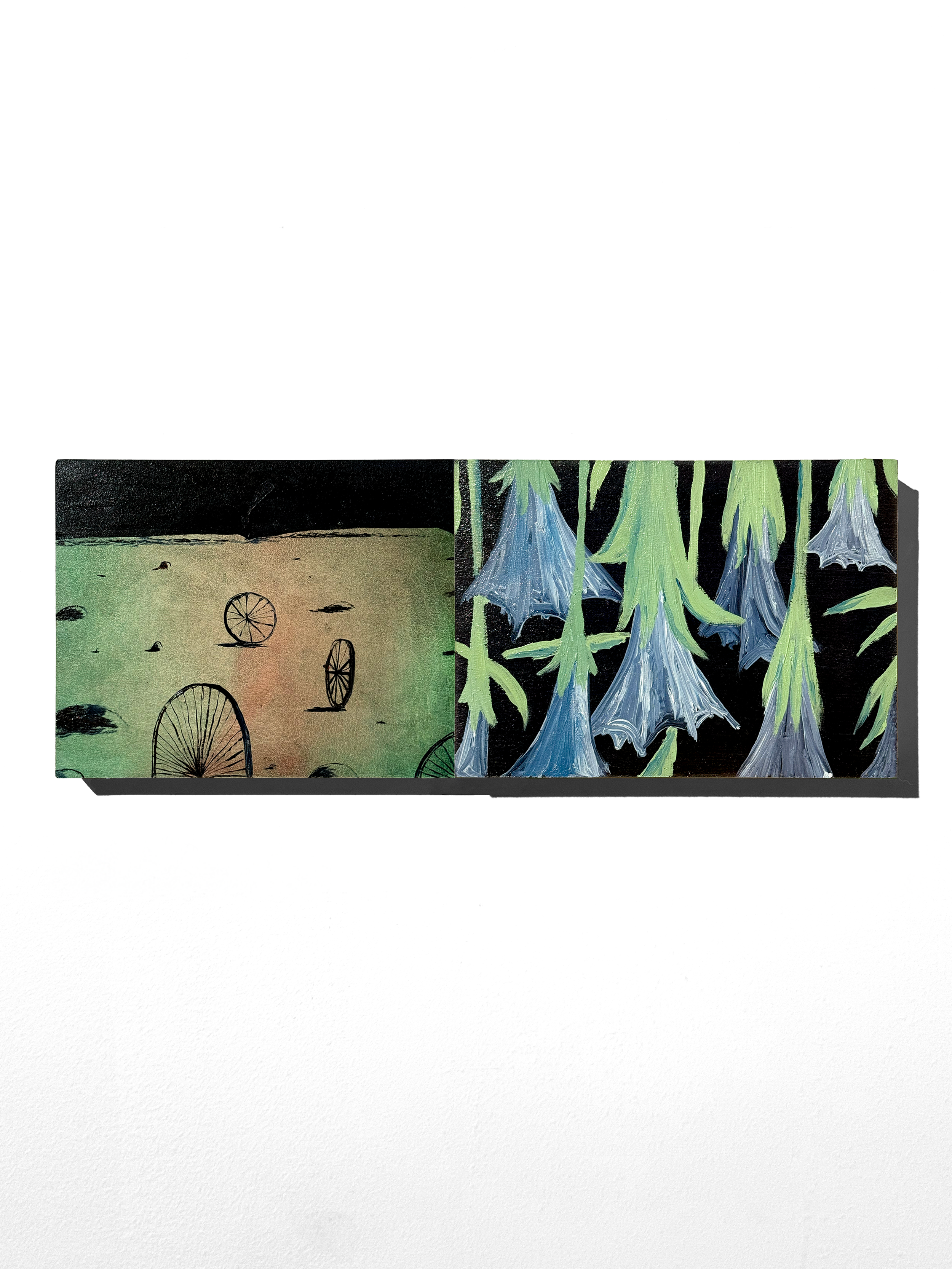
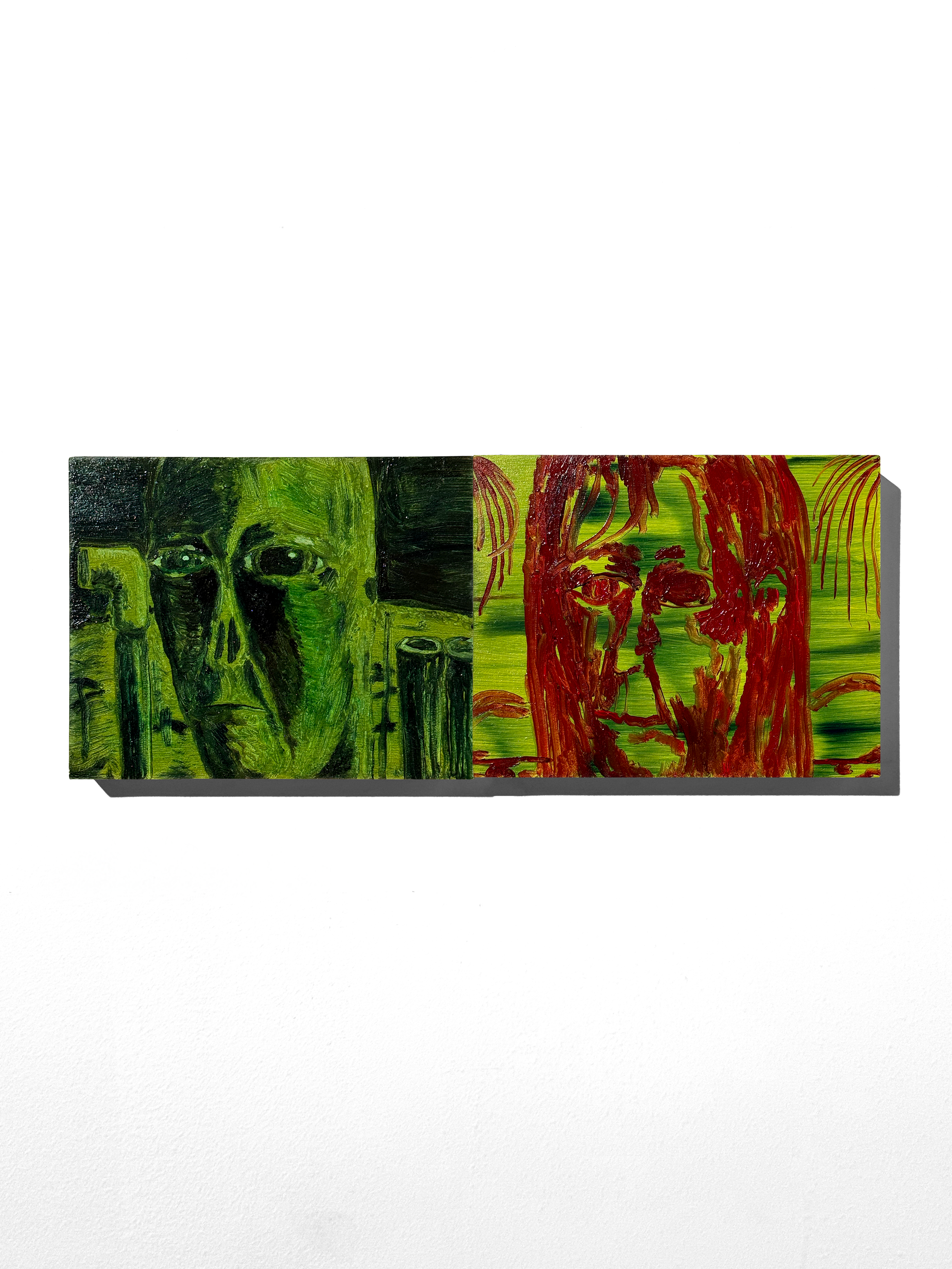
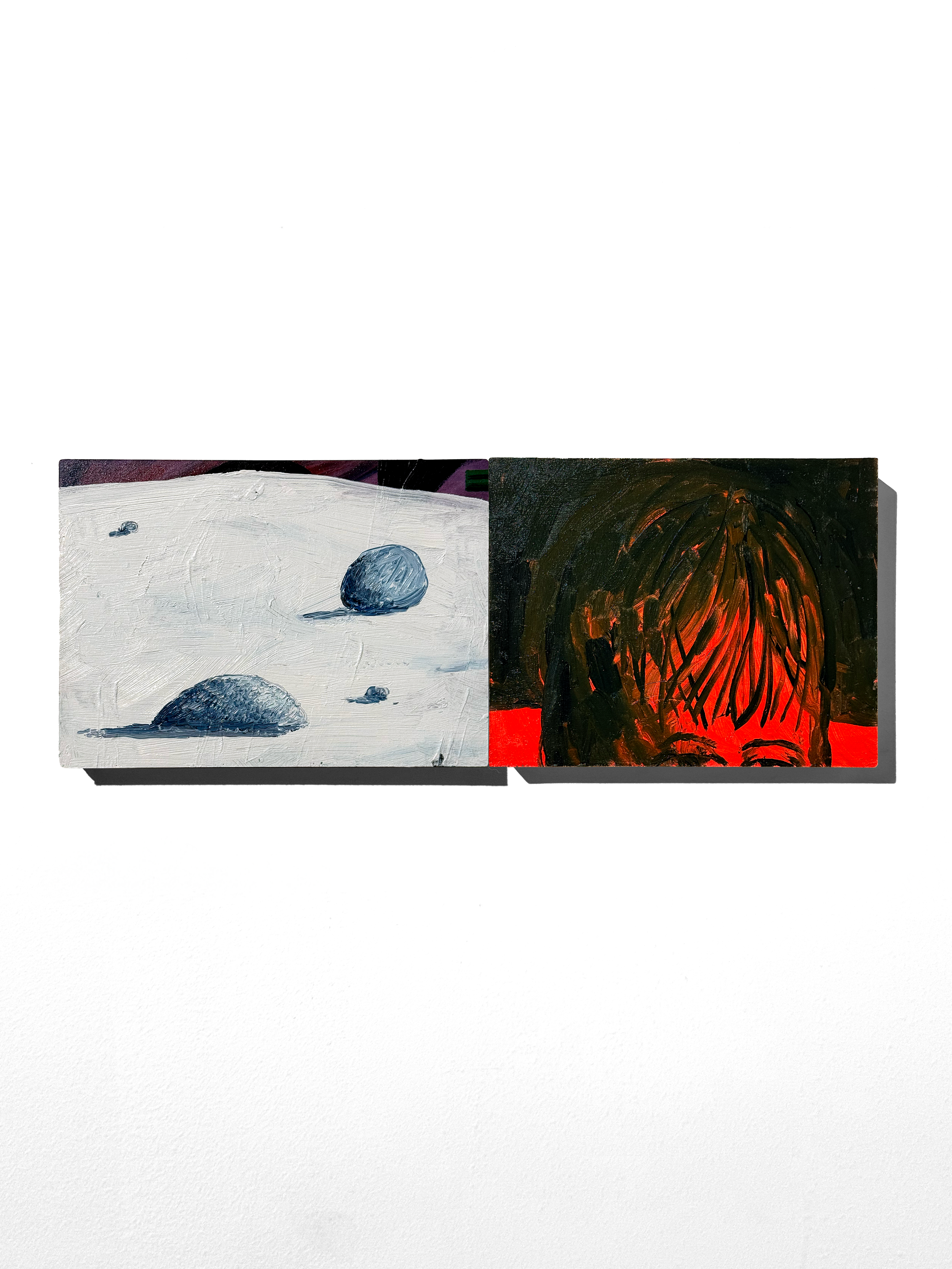
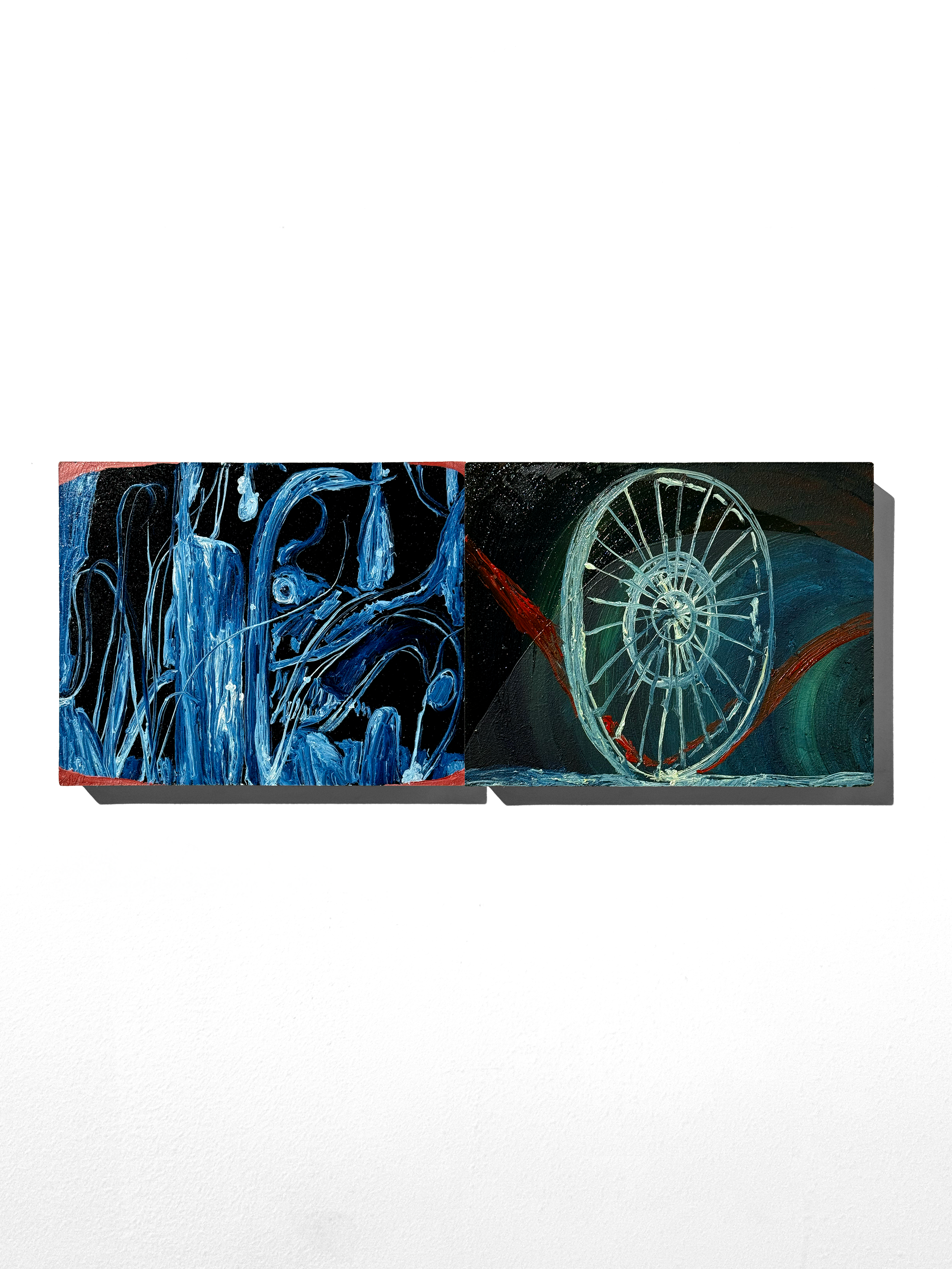
This was another proverbial tiny-cow-figurine-at-Zebulon moment: Griffin yet again offering an unexpected renewal of hope right as cynicism threatens to take hold. The hope came this time in the form of an exceptionally engaging conversation as he invited me to reflect with him on the landmark success of the show’s run.
What made this show such a preternatural stand out in my mind’s eye is the feeling of uncanny familiarity. There’s this sense that you’ve been here before, perhaps in a dream. This is indicative of Griffin’s focus on subconscious imagery and those elusive in-between states of being we all experience but struggle to articulate.
“My ideas come to me as I’m falling asleep.” he said to me about the conception of his images. We went on to discuss at length what he refers to as the long telephone game of memory: images becoming fuzzy with the passing of time and stories straying further from the truth the more that they’re told. Griffin Mactavish has made good use of this struggle with his own recollection, challenging himself to embrace this unknowing as space for imagination to take hold.
“Making sixty two paintings, it was like a bit of a challenge against AI image generation... we’re all just so bombarded with just the most fried imagery of all time. I feel like a lot of this is just trying to take back time and keep a record of time spent. A lot of that is frustration with my attention span being taken away from me.”
This speaks to Griffin’s rare capacity to approach art making with a refreshing sense of curiosity, exercising discipline without pretension. His practice is an inquisitive one, allowing the other aspects of his working life to inform the imagery he creates.
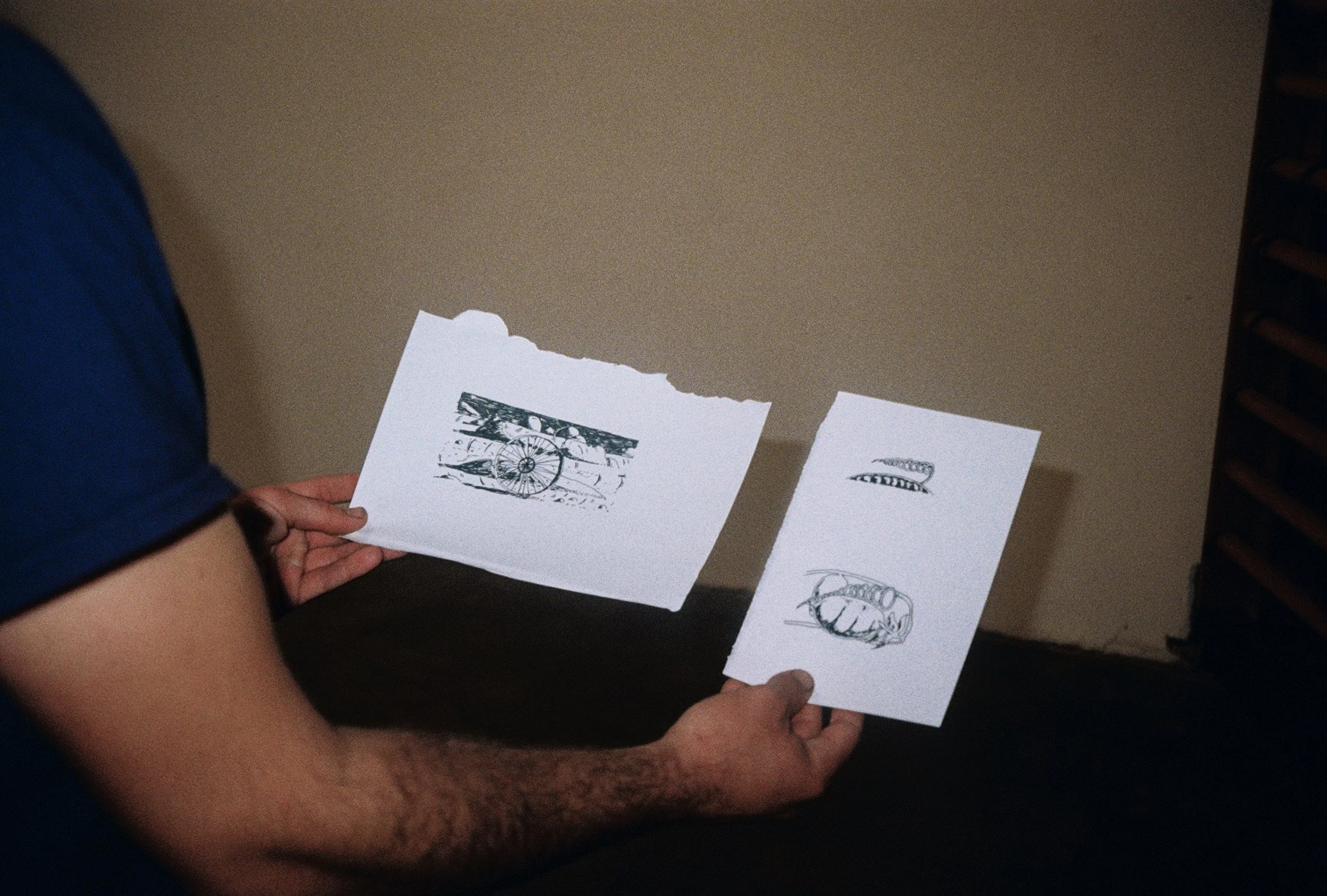
“I picked up a demolition job a couple years ago and I was making drawings that aren’t these for a year and a half. The working title for that series was ‘How Stuff Breaks’, because I was just dissecting houses, getting to know the systems of a house and a landscape. Learning how concrete breaks and the inner workings of a concrete slab and demolishing a chimney from the top down... taking a whole year to just draw on the same size paper and to just think about life in only black and white, it led me into these paintings in a way that I’d never painted before.”
This theme of dissection is foundational to the immersive experience of viewing Griffin’s work, a needed reminder of what it felt like when the whole world was new and playing was a tool for discovery- like climbing a tree just to see how high you could get, tearing up a plant not to kill it but to make sense of it, building forts out of fallen branches and found objects, the freedom of exploration we all once embraced before life got so serious. Griffin leads by example, holding onto this sense of play by keeping his process free flowing and interpretive. A paint smear in Griffin’s eye isn’t a ruinous thing, but rather a sunbeam.
“This series feels like going back to using painting as a drawing tool, and focusing on imagery while still responding to the materiality of it and letting it kind of shape what I thought of–kind of image association. I feel like I got to make a permanent record. This feels almost like a diary.”
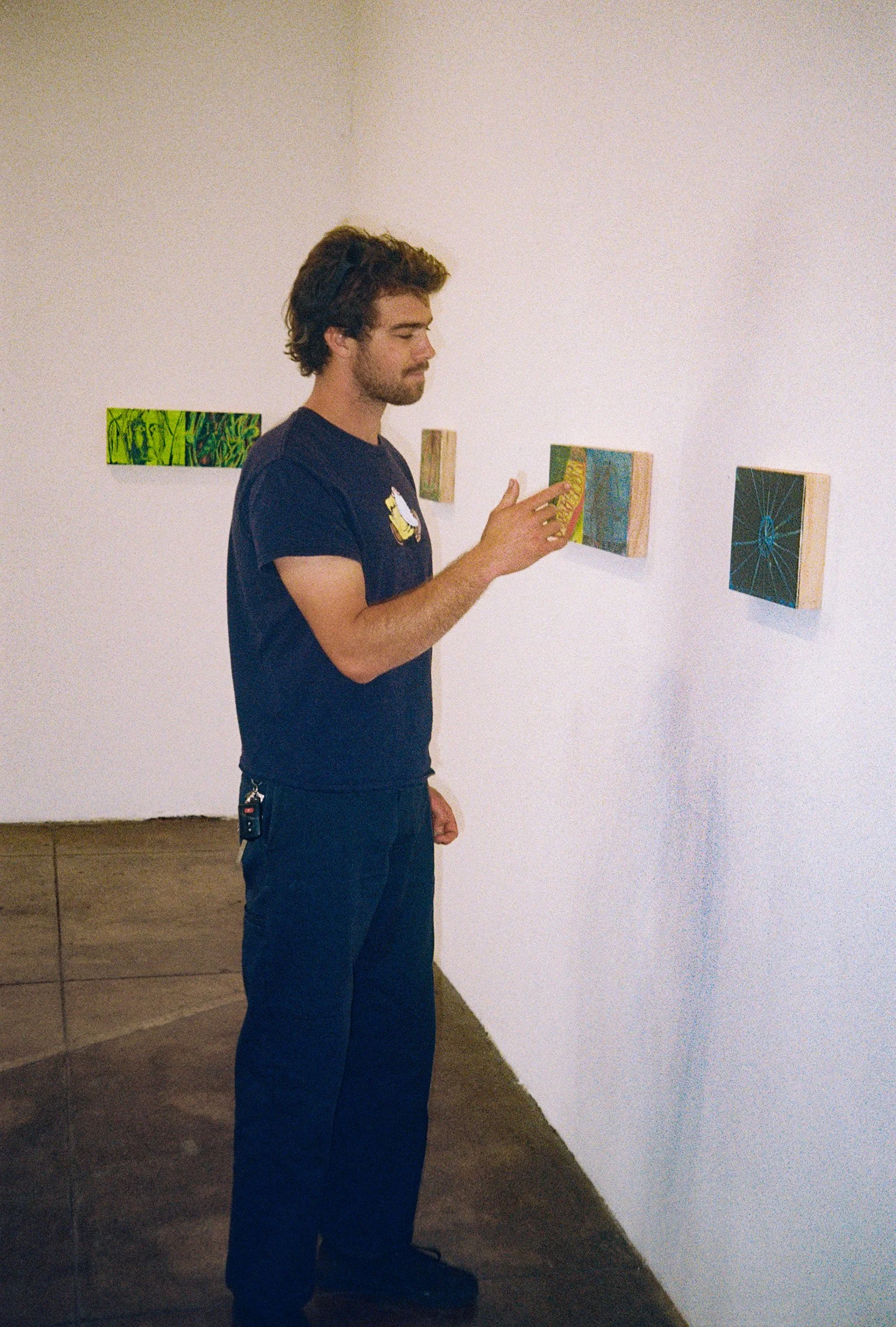
It reads like one too: an enthrallingly executed glimpse into the psyche of the artist, intimate yet relatable. He views this series as less of a linear narrative and more of an alphabet with which to piece together something like a story, using images when words fall short. “I think I’m better at it now, but when I was younger I was really bad at telling stories, like verbally talking through an entire story, it was really hard for me to articulate myself. So it’s fun to make these stories that don’t fully make sense, that you get a little bit of a glimpse rather than the full arc and the hero’s journey situation.”
The viewer gets a rare invitation to insert themself as characters in his not-quite-story through Griffin’s repeating thousand yard stare portraits, “protagonists” or “anti-heros” as he calls them. This collection takes the form of a choose your own adventure novel of sorts, in which the pieces reach their full potential long after the paint dries thanks to their interactive presentation. Griffin graciously credits his aforementioned collaborators, Lonestar Projects Alex and Maria for filling in these blanks.
“I read Maria’s write up before I installed the work and it definitely had a major effect on the way I installed and the narrative that happened . She used my work to create an entire new world or multiple worlds....Alex was a huge part of putting all these in order and pairing them up and working with someone else was a really important part of the process. Debating over that, about what the narrative should be was just an interesting process I’ve never really done with my own work. Which, for the ones I felt really strongly about I had to really justify why I felt so strongly. It made me learn about what my work meant more than before.”
To witness the expansiveness created by such free-flowing collaboration is a timely reminder that it does take a village, and Griffin is one of the most true villagers I’ve been lucky enough to encounter in this city. He is just so good, both as an artist and as a person. It’s a needed reminder these days to see that someone so benevolent can still experience well-earned success, but even more vindicating is the knowledge that success and attention are an afterthought for him. The process of creation is worthwhile in itself.
“Art is just a way of getting through your life and understanding. I’m obsessive about making things all the time, and I think for all of us it’s like a North Star. It’s like the act of becoming, all the time. If you see yourself as an artist and everything you do is a part of that, there’s a lot of pressure for living that way and seeing everything you do as important. But it doesn’t always have to be making something you’re going to sell. My studio is full of paintings that I haven’t even shown yet. It’s a compulsion to do this.”